
Where the Ideas Begin: Finding Inspiration for Frog Punk Studio
Inspiration is a funny thing because it rarely arrives in one neat little package. Most of the time, it starts with something small. It might be a color combination, an old book, a garden path, a vintage teacup, a sleepy cat, or a season that suddenly feels impossible to ignore. One little detail catches my attention, and then I start wondering what else belongs around it.
That is usually how a new Frog Punk Studio idea begins. I do not always know what the finished collection will look like right away. Sometimes I only know that I want it to feel cozy, playful, nostalgic, soft, or a little magical. The rest comes from following that feeling and seeing where it leads.
Inspiration From Everyday Things
A lot of inspiration comes from very ordinary places. Flowers, books, animals, kitchen shelves, old furniture, garden tools, fabrics, ribbons, baskets, pottery, and all the small things that make a space feel lived in can easily become the beginning of a collection. I think those everyday objects work so well because they already carry a sense of familiarity. A stack of worn books can feel comforting. A floral mug can make a scene feel homey. A lantern can turn an ordinary animal into part of a little story. Sometimes I notice one object and immediately start imagining the rest of the scene around it. That is often when an idea begins to grow into something larger.
Old Books, Vintage Objects, and Collected Things

I am naturally drawn to things that feel as if they have a little history behind them. Old books, antique-looking jars, worn wood, botanical illustrations, old-fashioned kitchen pieces, lace, brass, faded fabrics, and vintage furniture all tend to find their way into my ideas. I like the feeling of objects that look collected over time rather than perfectly matched. They make artwork feel warmer and more interesting to me. That does not mean every collection becomes vintage, but those details often help shape the mood. Even a simple animal can feel completely different depending on whether it is sitting beside a modern object or an old stack of books with a little lantern nearby.
Gardens and Nature
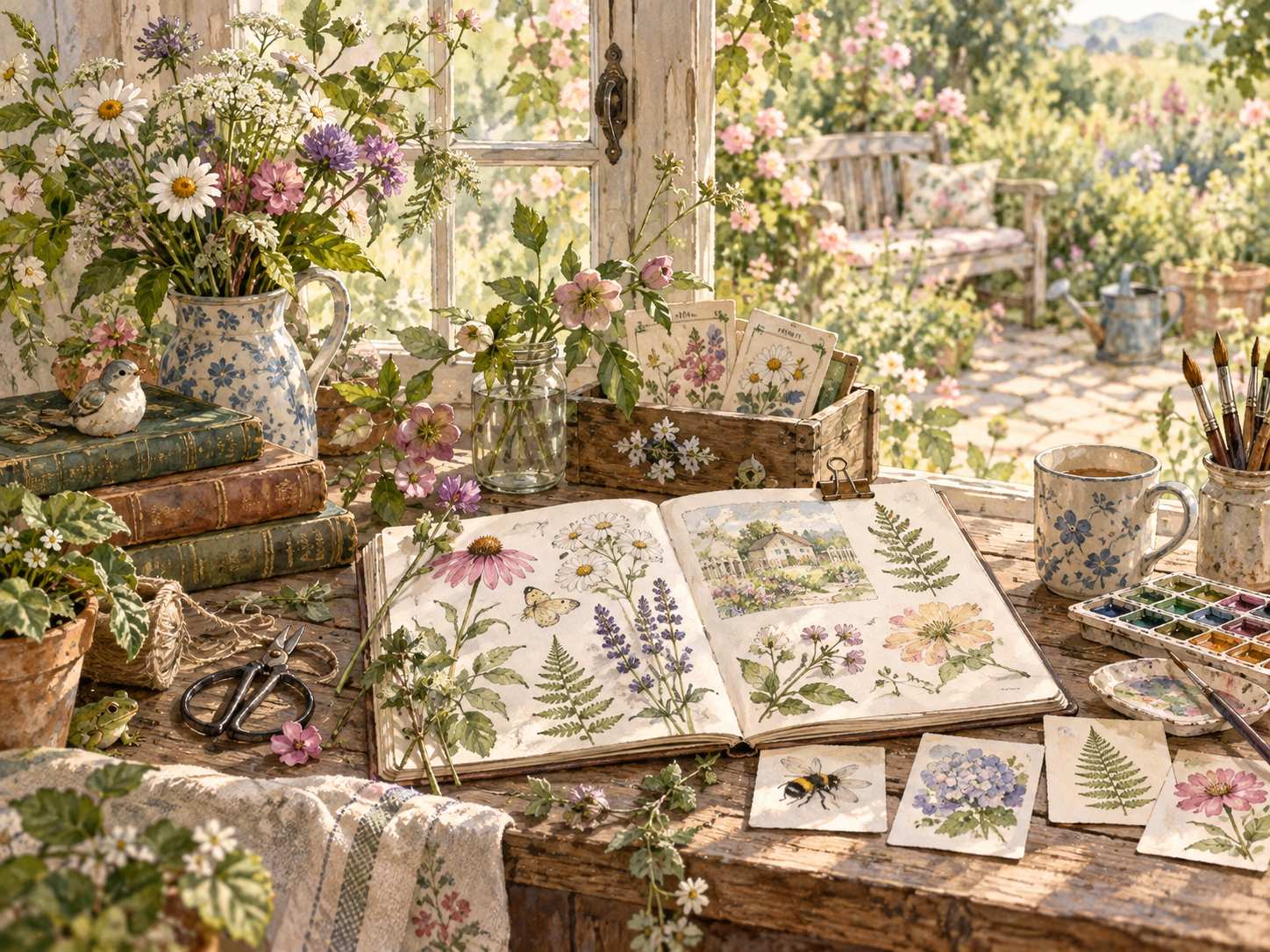
Gardens are another big source of inspiration. Flowers, leaves, mushrooms, berries, branches, birds, and little woodland details can change the entire feeling of an image. I especially like the imperfect side of nature. A branch leaning slightly to one side, a flower growing in an unexpected place, or a cluster of berries tucked behind some leaves usually feels more interesting than something arranged too perfectly. That natural irregularity is something I try to keep in the artwork too. I want collections to feel beautiful, but not so polished that they lose their personality.
Animals With a Little Character
Animals are probably one of the easiest places for an idea to grow. A rabbit is never just a rabbit for very long. Before I know it, the rabbit has a basket, a scarf, a stack of books, a flower crown, or some other little detail that gives it a personality. The same thing happens with cats, cows, mice, birds, frogs, and just about everything else.
I like imagining what kind of world an animal belongs in. Is it sitting in a garden? Carrying something home? Reading beside a lamp? Standing in the middle of an autumn field? Those small choices can turn a simple subject into something that feels more like a story.
Seasons Always Bring New Ideas
The seasons are probably one of the biggest sources of inspiration because each one comes with its own colors, textures, and traditions. Autumn brings pumpkins, leaves, apples, lanterns, warm fabrics, and deeper colors. Winter brings snow, evergreens, old-fashioned ornaments, quiet interiors, and softer palettes. Spring feels lighter with flowers, birds, fresh greens, and garden details, while summer often brings berries, coastal elements, sunshine, and more open color.
Seasonal collections are fun because they already come with a certain mood. The challenge is finding a way to make them feel familiar without making them look exactly like everything else. That is where the smaller details become important.
Color Often Comes Before the Subject
Sometimes the inspiration is not a subject at all. Sometimes it is simply a group of colors that I want to work with. A combination like dusty blue, sage, faded rose, and warm ivory can immediately suggest one kind of collection, while caramel, cranberry, mustard, and moss might lead somewhere completely different. Once I have a palette in mind, I start thinking about what belongs inside it. The colors can help determine whether the collection should feel calm, cheerful, rustic, romantic, playful, or slightly mysterious. I have learned that color can guide a collection just as strongly as the actual subject matter.
Looking at What People Are Searching For
Inspiration is not only about what I personally like. I also pay attention to what people are actually looking for. Research helps me understand which themes are popular, which ideas are already everywhere, and where there might still be room to do something a little different. Sometimes I will notice that people are clearly interested in a certain subject, but the available artwork all seems to follow the same direction. That is usually where I start asking myself how Frog Punk Studio could approach the idea differently. The goal is not to copy what is already popular. It is to understand what people enjoy and then find a way to make the idea feel like it belongs in the Frog Punk Studio world.
Inspiration Versus Copying
There is an important difference between being inspired by something and copying it. I may love the mood of an old botanical illustration, the color palette of a room, or the feeling of a particular season, but I do not want to recreate someone else's work. Instead, I try to figure out what I actually like about it. Maybe it is the muted colors. Maybe it is the sense of age. Maybe it is the balance between detailed and simple elements. Once I understand that, I can carry the feeling into something new rather than repeating what already exists. That part matters to me because I want each collection to feel familiar enough to be inviting, but still have its own personality.
Sometimes the Best Ideas Are the Smallest Ones
Not every collection starts with a grand idea.
Sometimes it begins with something very small, like a tiny frog, a mushroom, a teacup, or a little cat curled up beside some books. Those small ideas can be surprisingly useful because they leave room for the rest of the world to grow around them. I have found that the collections I enjoy most often start this way. There is one little detail that feels right, and then everything else begins to connect to it .A garden becomes a cottage garden. A cat becomes part of a reading room. A flower becomes part of a whole botanical collection. The beginning does not have to be complicated.
Letting an Idea Develop
Once an idea starts to take shape, I try not to force it too quickly. Some collections are clear almost immediately. Others change direction several times before they finally feel right. I may begin thinking a collection will be bright and cheerful, only to realize that it works better with softer colors and a quieter mood. Or I may plan a group of simple pieces and discover that the idea really needs more detailed scenes. That is part of the process. I think inspiration works best when there is enough structure to keep things moving, but enough flexibility to let the idea become what it needs to be.
The Frog Punk Studio Filter
By the time an idea becomes a finished collection, it has usually gone through what I think of as the Frog Punk Studio filter. That means asking whether it feels warm enough, charming enough, useful enough, and just a little unexpected. Does it have personality? Does it feel like something I would actually want to use? Does it fit with the rest of the studio without feeling like a repeat of something I have already done? And, occasionally, does it need a tiny frog somewhere? Sometimes the answer to that last question is yes.
There Is Always Another Idea Waiting
The funny thing about inspiration is that finishing one collection often leads directly to another. While I am working on flowers, I may notice a bird that deserves its own collection. While I am creating autumn artwork, I may suddenly start thinking about Christmas. One little detail that did not fit into the current project may become the starting point for the next one. That is probably why the idea list never really gets shorter. But I like that. It means there is always another little world waiting to be built.
